Windows and windmills and wings (oh my!): the imbalance of collision mitigation

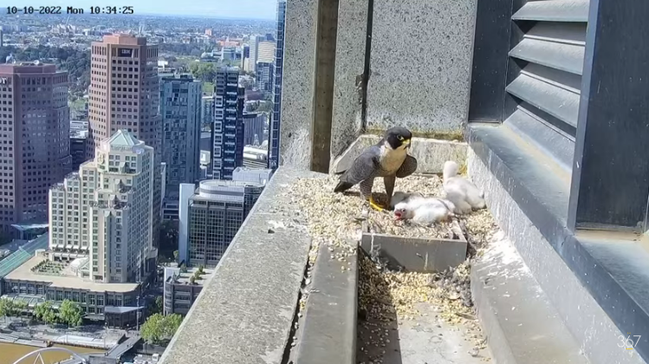
A few nights ago I was travelling by tram to dinner in the Melbourne CBD, and well above the city’s din a single cockatoo could be heard screeching as it tore its way through the airspace, navigating its way through skyscrapers and tramline power lines towards wherever it was going.
I had two simultaneous thoughts:
- How fkn cool is it that I can hear that bird over the noise of the city. Thank you universe for cockatoos. I love you little friend, I hope you're living the best cocky life possible.
- Imagine if we made property developers avoid and mitigate bird window collision risks.
To which you might respond:
- Noisy little bastard. But yeah, thank you universe for cockatoos.
- LOL what.
Birds have been flying literally headfirst into windows since humans started putting windows in their flight paths - which is everywhere. Just about everyone has experienced that jump-out-of-your-skin BANG of a bird colliding with a window, and then if they have a heart, the sickening panic while running out to check the status of the bird and what to do if it's still alive and what that's going to mean for the day's schedule. Maybe you're the type whose empathy is robust enough to put the bird out of its misery there and then. It's deeply unpleasant to say the least.
But despite this daily-occurring phenomenon, there is absolutely no obligation on property developers to do anything about the potential for window-collision, unless you're developing in the City of Parramatta in which case you are beholden to their Development Control Plan which includes Bird Friendly Design controls. Sure, there are potential offset obligations if they are clearing native vegetation, but for the most part no-one really gives a lot of thought to how often and in what numbers birds might fly into buildings. I don't think the general population thinks about it.
As you're likely aware, this is very different for wind farms. Like sticking a giant immovable box into the air, sticking a giant fan in the air can and does cause birds to collide with turbines. Depending on the species, some birds are more susceptible than others. Things like flight height, weather and climatic conditions, and hunting and courtship behaviours all play a role in how susceptible a bird species is to flying into a wind turbine. There's other things at play too, of course, like whether the species flies at night, and what their flight paths and migratory routes are, that can contribute to collision which also exist for property development. We know in Australia, for instance, that raptors are more susceptible to turbine strike than other types of birds.
In Australia, no one does any building collision mortality surveying or analysis for birds. Part of the challenge in collecting this type of data is that there are so many buildings and generally people will dispose of carcasses immediately if they can find the carcass at all because the bird may have flown off and died of its injuries later. I found a study this year that used data from the Australian Bird Identification Facebook group to try to create a picture of how many birds and of what kind are flying into windows. They're mostly smaller birds, suggesting that the collisions were reported by people in buildings of maybe 1 or 2 storeys, so we're not getting an idea of the mortality rates for city buildings or higher buildings.
Mortality monitoring is somewhat easier for wind farms because there are less wind farms to walk around. Depending on the frequency at which mortality monitoring is happening, the carcasses that can be attributable to turbine strike aren't immediately removed (unless an opportunistic scavenger has got to them).
Generally though, global literature shows that the number of birds killed annual by window-strike is in the hundreds of millions, if not billions. One US study from 2023 found that 'annual mortality may be minimally 1.28 billion–3.46 billion or as high as 1.92 billion–5.19 billion... with potentially billions more worldwide.' If we compare that with this 2024 study of global estimates of birds deaths per megawatt of wind energy, and yes I am currently cherry picking information based on some rudimentary search results, about 1000 gigawatts of wind energy generation will result in 1 million birds.
So a back-of-the-envelope calculation using very limited data shows that if conservatively use the lowest US annual window-strike mortality estimate as the annual global window-strike mortality 0f 1.28 billion, and use the estimated 2024 annual global turbine strike of 1 million, for every bird strike attributable to a wind turbine 1280 birds will die by window strike.
In Australia we have very poor data on turbine collision rates for birds, on par with the shitty amount of research we have about window-strike. Some estimates put the annual turbine-strike toll for birds at around 10,000 per year. Even if it is a bit more straightforward than window-collision mortality monitoring, wind farm mortality monitoring is expensive, time consuming, and traumatising for people who care about birds and who spend their working weeks picking up dead critters.
What we do know is that both windows and wind turbines kill birds, however inadvertently. All development that may have an impact on the environment, especially critters that have unfortunately and unknowingly found themselves on state and/or federal threatened lists in environmental law, is expected to undertake impact assessment and develop impact management plans to avoid, minimise and mitigate those impacts and where there is residual impact, those impacts need to be offset and/or compensated.
So why, then, does property development not receive anywhere near the same amount of scrutiny for impacts to birds - other than the removal of habitat - as turbines? Both the renewable energy transition and residential development are critical for Australia's future. Both are given expediency in government policy and tweaks are made to state planning frameworks to facilitate faster and more certain assessment outcomes. But only one of these development types has recently been subject to some $45m in federal research funding in the 2024-25 federal budget to assess the problem for federal environmental impact assessment and had every environmental consulting firm in Australia clawing each other out of the way to get access to and it wasn't property development.
And are all Australian environment departments developing bird (and bat) collision risk assessment frameworks, or impact assessment guidelines, or management plans for property development? LOL no, they are not. Are assessors in regulatory project assessment teams deciding that no, actually, we don't possibly have enough information to satisfy the precautionary principle that the Swift Parrot won't be impacted by this new coastal apartment block directly in the parrot's flight path?
Nope.
My point is that despite the general acceptance of the need for renewable energy development including wind farms and the need for a rapid increase in housing and other residential infrastructure to curb the housing stock and affordability crises, as far as I am aware no one in any Australian government (and I am happy to be wrong) is seeking to amend regulatory processes to protect birds from buildings. If we compare that with the incredible amount of regulatory energy and resources being thrown at bird collision with wind turbines there are two things going on:
- if we are supposed to be protecting nature from all threatening processes we're still doing a really bad job; and
- all that is happening is that we're regulating the heck out of wind farms whilst doing nothing to avoid, minimise or mitigate the impacts from other, equally (if not more) threatening processes.
To be clear, before people go stupid at me: my problem is with the inconsistency in the regulatory response to curbing bird mortalities from anthropogenic structures.
The mortality data, when we have robust and available data, will tell the story it tells about wind turbines and annual bird mortality, which critters are more at risk, and what can be done about it. I am not saying that the impacts to birds is minuscule compared to window-strike. I think that these types of arguments are lazy and deflect from the problem of bird mortality rates.
If Australia intends to make good of the incredible amount of effort going into environmental law reforms at the federal level, wants to close the research gap on impacts to threatened birds, and wants to deliver net positive gains for birds at risk of impact from anthropogenic development we have to stop pretending that throwing the regulatory book at one sector is going to solve the problem. Or that the money that sector can provide in compensatory, research, and monitoring efforts is going to solve the problem. It won't.
All it does is slow down wind farm assessments and spook investors. And while we take up to 12 years to approve a wind farm, the life of aging coal-fired power stations is prolonged and we take longer to decarbonise the energy sector. Which means it's harder to mitigate climate change, which has and will fucking kill everything in numbers far more significant than either wind farms or property developments.
So what does evening the playing field here look like? Some spit-balled ideas for building design and regulation could be things like:
- no-go property development zones in areas with high biodiversity value.
- prepare national guidelines for assessment of window collisions for birds, including demonstrable application of the mitigation hierarchy including demonstrable iterative site choice and design to avoid removal of bird habitat and avoid/mitigate etc collision impacts.
- insert mandatory bird-saving measures into the National Construction Code, like painting UV stripes that birds can see but humans cannot.
- mortality monitoring and reporting programs required as part of building maintenance practices and body corporate bylaws so that every time a mortality event occurs it is recorded and reported on annually.
- Hell, even the unions could care about it more. Maybe the C part of the CFMEU could start to rebuild its social licence with the broader Australian community by training construction workers to monitor and report on bird and bat mortalities at skyscraper construction sites.
I am sure the property developers are going to come for me. I'm ready. In the meantime, I will listen out for that cocky next time I'm in the city and I hope that it screeches above the din like that for the rest of its life.
P.S. I haven't said anything about bats. That was deliberate. I will write about bats later.
*Updated 11 August to fix some typos and better represent the annual global window-strike v annual global turbine strike kill ratio.
Fun stuff I have watched lately
For something completely different but no less dramatic, I am obsessed with the Reckless Ben v Bricks and Minifigs saga. It has Lego. It has a corporation stealing from a little old man. It has corrupt cops. It has the type of smart arse that makes the world a better place. Enjoy.